Table of Contents:
Introduction
Most enterprises are not constrained by a lack of AI activity. Chatbots support customer service, forecasting tools inform operations, and GenAI assistants accelerate engineering. The strategic challenge is fragmentation: these capabilities operate independently, with separate architectures, governance models and performance measures. As a result, AI remains adjacent to the business rather than embedded within it.
When AI is not embedded in the processes that drive revenue or reduce cost, it remains a project rather than an enterprise capability. It may perform well in a demonstration, yet rarely translates into measurable P&L impact. As additional agents and models are introduced, complexity and cost compound because each line of business recreates the same foundational capabilities.
Three structural failures recur across enterprises, with distinct implications for leadership:
- For business unit leaders: AI remains disconnected from the processes that influence material P&L outcomes.
- For the CFO: AI expenditure lacks use-case-level unit economics, making investment difficult to justify and optimise.
- For the CISO and regulators: AI decisions cannot be reconstructed reliably for audit, limiting enterprise acceptance.
Without an operating-system layer, these control, cost and accountability gaps expand with every new agent deployed.
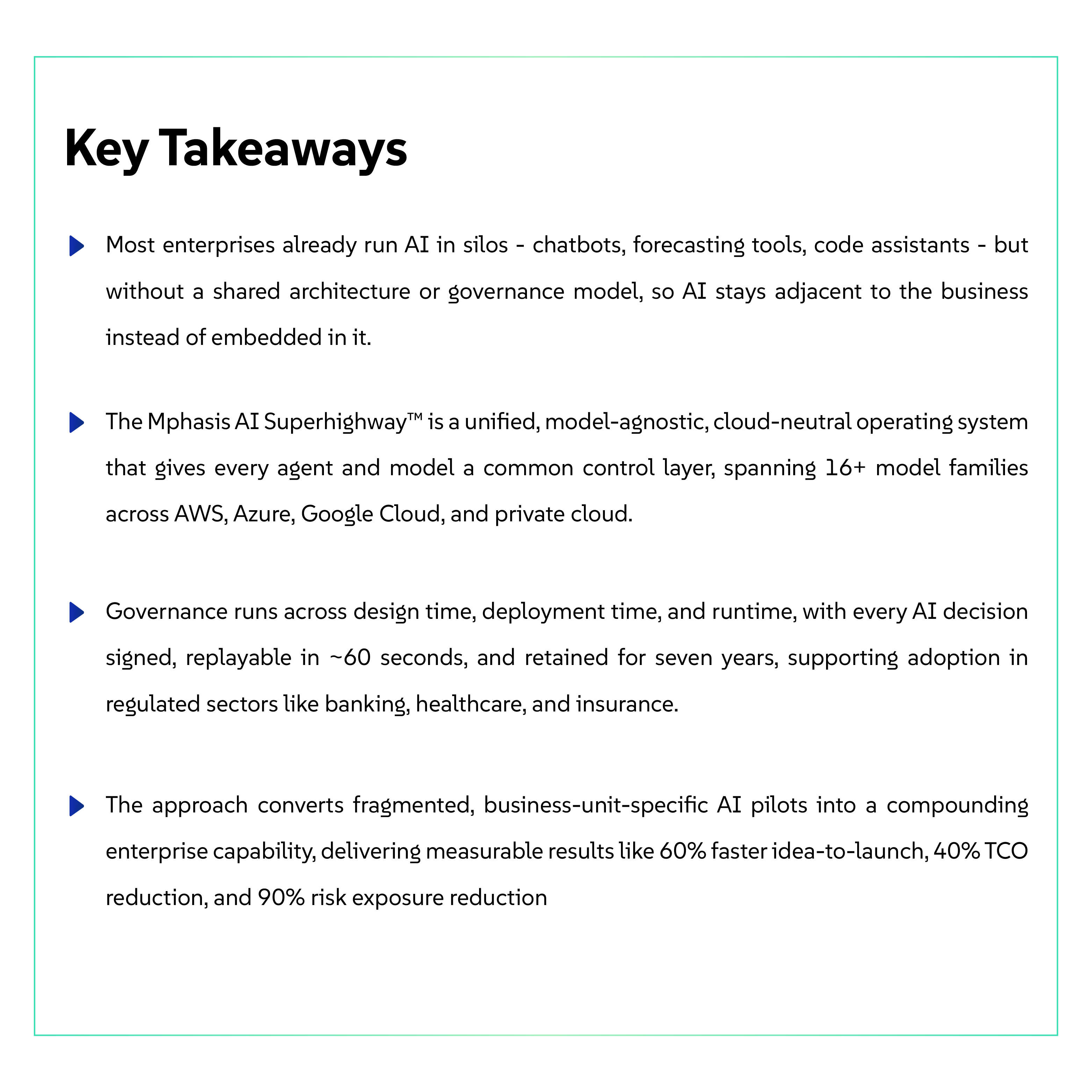
The Mphasis AI SuperhighwayTM is designed to address these three gaps through a model-agnostic, cloud-neutral operating system that provides every enterprise agent and model with a common control layer. The intended outcome is a shared enterprise foundation that replaces fragmented, business-unit-specific infrastructure.
Context / Challenges
AI Initiatives Confined to Siloed Pilots
Most AI programmes begin with individual teams addressing specific operational priorities. Customer service deploys a chatbot, finance develops a forecasting model, and technology introduces a code assistant. Although each solution may perform effectively within its domain, it is often built on different tools, data and governance standards. Per-agent projects do not scale; shared primitives do.
In many enterprises, agent inventories remain distributed across team-level spreadsheets that quickly diverge. Onboarding and retirement processes are designed independently, while accountability is often unclear when an agent underperforms or behaves unexpectedly. The result is an expanding portfolio of disconnected AI systems that is difficult to reuse, govern or extend.
Desired outcome: a single, shared registry of agents, models and prompts that enables every team to discover, reuse and extend approved assets, replacing fragmented team-maintained inventories.
Hard to Scale AI Across Multiple Business Units
When a pilot succeeds in one function and the organisation seeks to scale it, the solution often requires substantial rebuilding. Business units operate with different infrastructure and approval processes, turning expansion into a complex and costly undertaking. The result is repeated investment in the same foundational capabilities across the enterprise.
Lack of Centralized Governance and Control
As enterprise AI adoption expands, oversight becomes increasingly complex. Without a central framework for policy, identity and accountability, the CFO cannot validate use-case economics, the CISO cannot determine which agents access specific data, and auditors cannot reconstruct decisions from their underlying inputs. These limitations are particularly consequential in highly regulated sectors such as banking, healthcare and insurance.
Inconsistent AI Deployment Standards
AI deployment standards often vary materially across teams. Some apply rigorous validation and testing, while others prioritise speed over control. Pre-deployment gates are designed to prevent promotion when mandatory artefacts are missing, including a signed model card and lineage record, completed evaluation thresholds, a passed security scan, a cost-tier classification and a privacy-impact reference. Without consistent gates, enterprises cannot establish reliable production standards or respond systematically when performance falls outside expectations.
Fragmented Infrastructure for AI Development and Execution
Enterprise AI depends on data distributed across cloud environments, legacy platforms and function-specific databases. The platform applies a contract-first rather than schema-first approach: every input must arrive under a data contract, with field-level lineage and measured service-level objectives. This discipline reduces integration overhead and prevents each initiative from rebuilding foundational data connections.
Limited Visibility into AI Lifecycle Performance
Once AI enters production, many enterprises lack a consolidated view of performance, drift and cost. The platform's observability layer monitors five telemetry types - metrics, logs, traces, evaluations and drift - across eight named dashboards spanning model performance, FinOps and compliance. Without this central visibility, issues remain undetected and business value gradually erodes.
Trouble Integrating AI into Workflows
To generate measurable impact, AI must be embedded within the tools and workflows employees already use. The platform integrates rather than replaces: every AI action is recorded as a typed record within the existing ITSM workflow and moves through the business-process engine as a six-element BPMN step. When AI remains disconnected from operational systems, insights do not consistently translate into action.
Mphasis’s Approach
A Unified AI Platform for Centralized Orchestration
The Mphasis AI SuperhighwayTM is anchored in a two-part strategic premise: embed every form of AI into business processes and scale adoption with guardrails active from the outset. Embedding without guardrails compromises control; guardrails without embedding constrain value realisation. The platform brings data, models, agents, governance, workflows and business systems under a unified control layer. It is model-agnostic across more than sixteen model families and cloud-neutral across AWS, Azure, Google Cloud and private cloud, providing a common enterprise foundation.
For CIOs, this reduces technology fragmentation and accelerates adoption. For business leaders, it converts isolated pilots into measurable enterprise outcomes.
Standardized AI Deployment Frameworks
The platform provides standardized deployment pipelines and a shared marketplace through which teams can publish, approve, consume, fork and specialise approved assets. These assets extend beyond models to include agents, prompts, tools, ontology fragments, evaluations, policy bundles and datasets. Each asset progresses through one of three tiers - experimental, certified or enterprise-wide - with increasingly rigorous gates, reducing duplicated effort and establishing consistent production standards.
For technology leaders, this reduces duplicated investment. For delivery teams, it shortens the path from concept to production.
Enterprise-wide AI Integration Capabilities
The Mphasis AI SuperhighwayTM connects AI directly to the systems in which work is executed. AI actions become typed ITSM records, move through a six-element BPMN process model and trigger versioned decision tables within the rules engine, rather than remaining in standalone dashboards. The platform does not replace systems of record or resell hyperscaler infrastructure; it embeds AI into the former and operates on the latter.
For business leaders, this translates AI investment into measurable operational gains. For CIOs, it accelerates adoption without requiring wholesale replacement of existing systems.
Governance-driven AI Enablement
Governance is embedded across design time, deployment time and runtime on a common mesh, with every action signed and replayable through a single decision ID. Policy-as-code is versioned in Git and deployed through CI/CD; pre-deployment gates prevent promotion when required artefacts are absent; and runtime guardrails apply input filters, output filters and circuit breakers. Every inference generates a decision ID that enables inputs, model version and policy version to be rehydrated, compared and replayed in approximately sixty seconds, with the signed evidence bundle retained for seven years. This architecture supports enterprise AI adoption in regulated sectors such as banking, healthcare and insurance while maintaining control and auditability.
For CISOs and risk teams, this strengthens oversight and audit readiness. For regulated enterprises, it enables AI adoption without compromising compliance control.
Lifecycle Management Across AI Models
The platform manages every AI model through a seven-state lifecycle: onboard, validate, approve, deploy, monitor, challenge and retire, with three model-risk-management gates. Models are classified by materiality: Tier 1 high-materiality models receive annual revalidation and board-level reporting; Tier 2 operational models receive biennial revalidation; and Tier 3 internal-productivity models require lightweight owner attestation. This end-to-end visibility allows enterprises to improve AI performance continuously while retaining control over production environments.
For risk teams, this strengthens visibility and accountability. For business stakeholders, it sustains value creation while limiting operational and compliance exposure.
Scalable AI Infrastructure Foundation
The Mphasis AI SuperhighwayTM is built on a cloud-native, model-agnostic and cloud-neutral foundation with multi-tenancy and cell isolation. It supports a four-tier model portfolio-frontier, mid-tier, small language and tiny on-device models-using a right-sizing router that invokes the smallest suitable model first and escalates only when required. This approach delivers a 40-70% cost reduction while retaining 95-98% of frontier-only quality, enabling enterprise-scale workloads without a major infrastructure overhaul.
For CFOs, this provides stronger cost discipline. For CIOs, it creates the capacity to scale without a major infrastructure overhaul.
Structured Enterprise AI Transformation Roadmap
Mphasis applies a phased approach to enterprise AI adoption. The fast path delivers one to two quick-win use cases during weeks zero to four using existing tooling and lightweight governance, while the Hub is developed in parallel. The Hub reaches minimum viable status by month six; the first wedge use case enters embedded production with a chartered governance committee by month seven; and the first full line of business-the first ‘Spoke’ - onboards and publishes its first marketplace asset by month nine.
Execution is governed through named decision gates at D30, D60, D90, D120, D150 and D180, each with a designated owner. This structure gives technology and business leaders transparent progress measures and clear accountability
Case Study
Client Overview
Engagements following this framework typically begin with substantial AI activity distributed across business units-for example, advisor-productivity tools in wealth management, AML transaction monitoring in risk, code agents in engineering and AIOps automation in IT operations. Each initiative is often built independently on different tooling, without a shared foundation. The engagement objective is a governed operating system in which every business event on the OS-managed path passes through four governance gates: bind owner, stamp policy, meter cost, and sign and append-addressing the three structural failures identified above.
Business Challenges
The AI landscape often grows faster than the enterprise's ability to govern it. Different business units operate under distinct infrastructure models and approval processes, limiting the reuse of successful capabilities across functions. Leadership consequently has insufficient visibility into what is running, what it costs and whether it is generating value. The requirement is a framework that brings order to the AI estate by assigning a process owner to every agent, binding each model to a risk tier and metering cost per decision - without disrupting initiatives already in progress.
Solution Implementation
The Mphasis AI SuperhighwayTM gives these enterprises a single governed foundation across four embedding patterns, Grow, Change, Run and Protect, each owning a distinct, mutually exclusive line on the P&L: top-line revenue, the combined speed of Grow and Run, bottom-line cost and reliability, and loss avoidance from fraud and compliance failures. Standardized deployment pipelines and shared governance gates replace the patchwork of team-level processes. A centralized agent and model registry gives leadership visibility into every use case, where it's running, and how it's performing.
The platform integrates AI directly into operations spanning agentic workforce augmentation in advisory and contact centers, AI-embedded software delivery across the SDLC, self-healing AIOps in IT operations, and agentic cybersecurity across the kill chain, all managed through the same unified control layer.
Business Benefits Achieved
- 60% faster idea-to-launch and 70% acceleration on legacy modernization ("Relearn") work, through AI-embedded software delivery
- 30% advisor productivity lift in wealth management engagements
- 40% total cost of ownership reduction
- 98% service reliability and 40 to 60% Level-1 ticket automation through AIOps
- 90% risk exposure reduction and 40% security incident reduction through embedded guardrails
- 40% compliance cost reduction
- Audit reconstruction for any AI decision in roughly 60 seconds, signed evidence retained for seven years
The engagement evidence demonstrates the value of connected and governed enterprise AI for the stakeholders who matter most: the CFO gains visibility into unit economics, the CISO can trace every agent, and the auditor can replay any decision. AI therefore shifts from a portfolio of isolated experiments to a coordinated enterprise capability that delivers sustained business value.
Frequently Asked Questions
Why do most enterprise AI initiatives fail to scale?
Per-agent projects do not scale; shared primitives do. Many enterprises build AI in silos, with teams using different tools, data and governance standards and operating without a shared registry, common lifecycle or clear accountability. Individual pilots may succeed, but they cannot be reused or scaled without substantial rebuilding.
What is the Mphasis AI SuperhighwayTM?
The Mphasis AI SuperhighwayTM is a unified, model-agnostic and cloud-neutral operating system that provides every enterprise agent and model with a common control layer. Its two-part premise is to embed every form of AI into business processes while scaling adoption with guardrails active from the outset.
How does the platform ensure governance and compliance?
Governance operates across design time, deployment time and runtime through policy-as-code, pre-deployment gates and runtime guardrails. Every decision carries a signed decision ID that can be replayed by rehydrating inputs, model version and policy version in approximately sixty seconds, supporting dependable operation in regulated sectors such as banking, healthcare and insurance.
What real-world results has the Mphasis AI SuperhighwayTM delivered?
Customer engagements report a 60% faster idea-to-launch cycle, a 30% increase in advisor productivity, a 40% reduction in total cost of ownership, 98% service reliability through AIOps and a 90% reduction in risk exposure. Individual AI decisions can be audited and replayed in approximately sixty seconds.
Conclusion
Scaling AI is not primarily a technology challenge; the enabling technologies already exist. The strategic gap is an operating system capable of sustaining both requirements simultaneously: embedding every form of AI into business processes while maintaining guardrails from the outset.
The Mphasis AI SuperhighwayTM provides this structure through a unified, model-agnostic and cloud-neutral platform. It enables enterprises to grow revenue through agents working alongside employees in top-line functions, accelerate change through AI-embedded software delivery, improve operational efficiency through self-healing AIOps, and protect the organisation from fraud, security and compliance risk. These capabilities operate within a governed, scalable foundation in which every decision is replayable in approximately sixty seconds.
With the appropriate operating system in place, AI evolves from a portfolio of disconnected projects into a compounding enterprise capability. Each embedded use case contributes reusable marketplace assets, accelerates subsequent deployments, reduces use-case-level cost and improves regulatory clearance through reliable audit replay.